Top Signs You Need Garage Door Service – Don’t Ignore These
A garage door that takes two seconds longer to close than it did six months ago isn’t just aging. It’s telling you that one specific component is wearing down, and that component usually costs around $80 to fix now and closer to $400 to fix once it takes other parts with it. We see this constantly in Wayne, NJ. The homeowners who call when the door first starts acting strange almost always spend less than the ones who wait until something snaps. If you’d rather not diagnose it yourself, call (833) 482-6691 and we’ll tell you what’s going on.
Why “It Still Opens” Is the Most Expensive Sentence in Garage Door Ownership
The door still opening isn’t proof it’s fine. Most of the failures we handle in Wayne start weeks before the door actually stops working. A spring loses tension, a roller flattens, a cable starts to fray, and the door keeps going up and down while each of those small problems loads more stress onto the parts still doing their job. Then one day it stops, and now you’re paying to replace a spring and the bent track and the opener gear that got chewed up when the spring finally let go.
The signs below aren’t random annoyances. Each one points to a specific part, and each one has a predictable failure timeline. Treat them as data, not noise.
Key Takeaways
- A door that’s slow going up almost always has a spring problem, not a failing opener motor.
- Vibration during operation usually means worn rollers or a misaligned track, not the opener.
- New Jersey winters turn light track rust into roller failure faster than most people expect.
- An opener that needs three presses but not one points to the logic board, even after new batteries.
- A frayed cable is already a failure waiting to happen, no matter how much of it is left.
The “Slow on the Way Up” Pattern
If your door climbs more slowly than it used to, especially in the first few feet, the problem is almost always spring tension loss rather than opener motor wear. Homeowners jump to the opener because it’s the part that makes noise and has a motor, but the springs are what actually do the lifting. As torsion or extension springs fatigue, they carry less of the door’s weight, and the opener has to work harder to make up the difference. That extra strain is what eventually burns out the opener gear, which is exactly how an $80 spring job becomes a $400 opener job.
Here’s a 30-second visual test you can do without touching anything that moves. Disconnect the opener with the release cord and lift the door about halfway by hand. A healthy door stays where you put it. A door that sinks back down on its own has lost spring tension and needs attention soon. If you can’t lift it comfortably by hand at all, stop and call someone. This is high-tension spring work and it’s dangerous, which is why our technicians handle it rather than homeowners.
When the springs are the culprit, our garage door spring repair service replaces them properly and resets the balance so the opener isn’t straining anymore. Fix the spring first and the opener lasts.
What Door Vibration Actually Means
Shaking, rattling, or a door that shudders on the way down usually points to worn rollers or a track that’s drifted out of alignment, not the opener motor that gets blamed for it. Rollers are the small wheels that ride in the tracks, and they wear flat or seize up over time. When one stops rolling smoothly, the door jerks and vibrates as it moves. Track misalignment works the same way: a track knocked slightly out of line makes the door bind, and the whole assembly shudders. Opener motors are rarely the cause of vibration because they don’t control the door’s path, the tracks and rollers do.
What vibration doesn’t usually indicate is an opener problem, even though that’s the first thing most people suspect. If you can hear where the noise is coming from, listen for it down at the door itself rather than up at the motor housing. If the shaking comes from the panels and the tracks, you’re looking at a roller and alignment issue.
Left alone, a vibrating door grinds its rollers down further and slowly wears the tracks. That’s when a simple roller swap turns into a full track and roller replacement. Our garage door repair service handles both, and we can tell you which parts are actually worn versus which ones are fine.
The Rust-and-Binding Cycle in New Jersey Winters
Wayne winters are hard on garage door hardware. Road salt on the driveway, damp air, and repeated freeze-thaw cycles put surface rust on steel tracks and hinges faster than most homeowners expect. That rust is the beginning of a cycle. Rust roughens the track surface, the rollers drag instead of gliding, and the extra friction wears the rollers and springs. By the second freeze season, what looked like light surface rust has turned into binding, squealing, and parts that need replacing.
The cycle moves in roughly this order:
- Surface rust appears on the tracks and hinges.
- Rollers start dragging and the door gets noisier.
- Springs and the opener work harder to overcome the friction.
- Rollers fail and the door binds, jerks, or comes off track.
The smart move in Wayne is to have the door serviced and lubricated before that second winter, while the rust is still cosmetic. A light cleaning and proper lubrication on the moving parts breaks the cycle early. Once rollers seize, you’re no longer preventing a problem, you’re replacing parts.
An Opener That Works on the Third Press But Not the First
If your opener needs two or three presses to respond but the remote batteries are fresh, the problem is likely the logic board, not the remote. Homeowners change the batteries first (fair), then assume the remote is bad and buy a new one (also fair). When neither fixes it, the signal is coming through fine but the opener’s control board isn’t processing it reliably. That’s a board health issue, and it tends to get worse. A board that hesitates now can fail to close the door completely later.
This is where knowing the specific brand matters. We work with LiftMaster and Chamberlain systems every day, along with Genie, Craftsman, and Raynor openers, so we know how each one behaves when its board is on the way out. The fix is usually a board replacement rather than a whole new unit. Our garage door opener repair covers the app-connected LiftMaster and Chamberlain myQ systems as well as older legacy openers, so you don’t have to figure out which era of hardware you’re dealing with.
The Cable Fraying Inspection
A frayed cable is a safety problem, not a maintenance item, and a cable that’s only 30% intact is already a failure waiting to happen. Cables hold the door’s weight alongside the springs. When strands break, the cable loses strength fast, and a snapped cable can send a door crashing down. Check two spots on each side: the cable drum at the top of the door, and the lower bracket where the cable attaches. Early-stage fraying looks like a few loose or broken strands poking out of the braid, or a cable that’s started to kink or birdcage near the drum.
Do this check with your eyes only. Don’t put your hands near the cable under any tension, and don’t try to rewind a cable that’s come off its drum. That’s a trained-technician job, and we handle it as part of spring and cable service. If you see broken strands or an uneven cable, call rather than wait. A cable that fails under load is one of the few garage door problems that can genuinely hurt someone.
When to Call a Pro
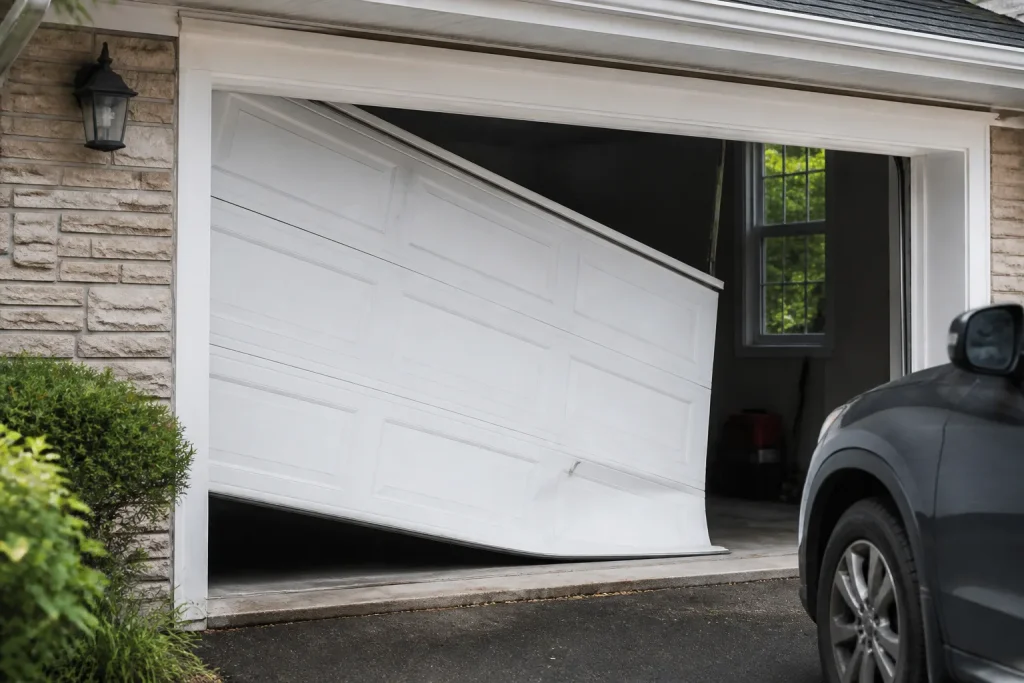
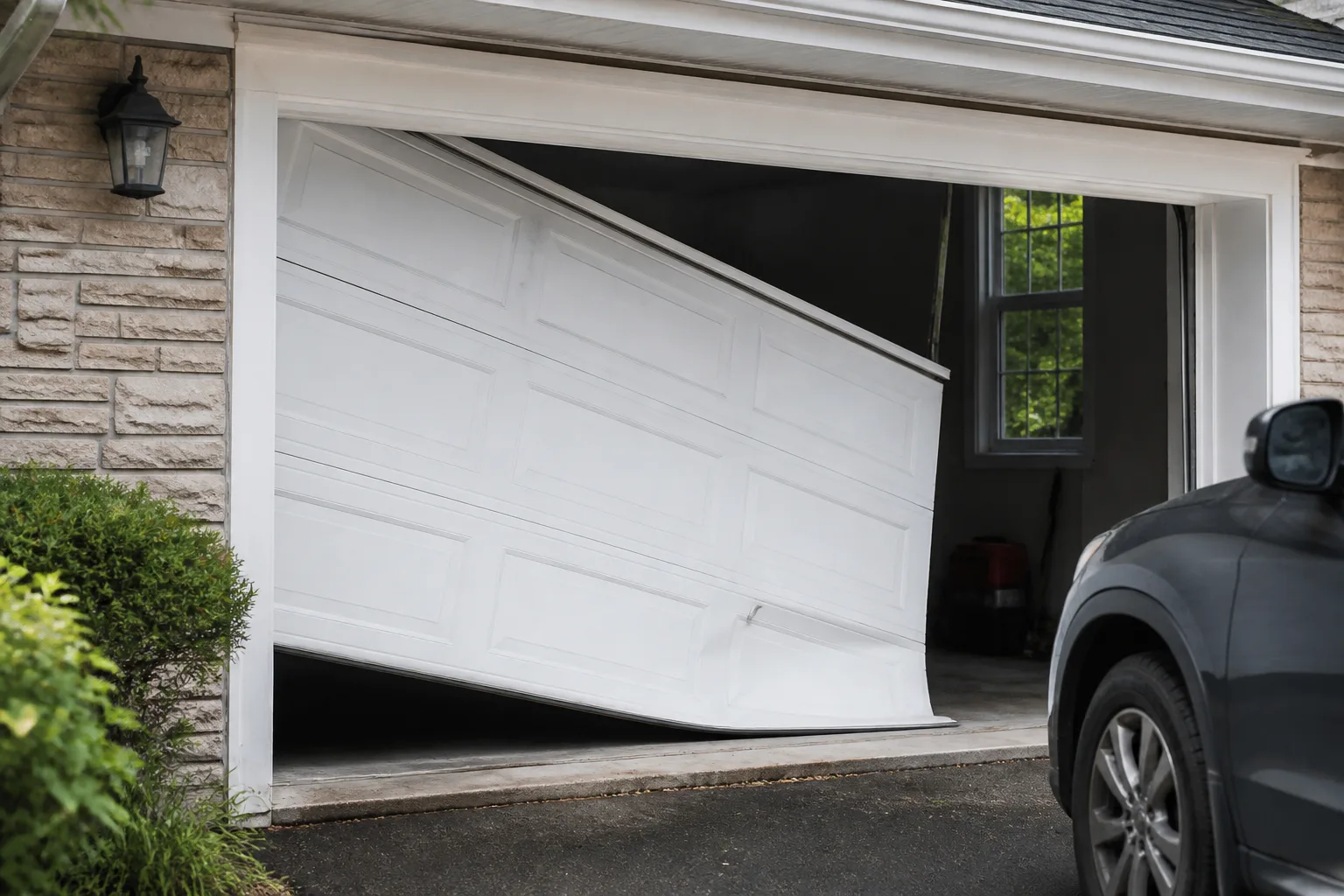
Some symptoms are annoyances you can live with for a few weeks. Others need a call now. Call right away if you see a frayed cable, a door that slams down instead of lowering smoothly, a door that’s come off its track, or a spring that’s clearly broken (a gap in a torsion spring, or an extension spring that’s stretched out and hanging). These aren’t things to test or tinker with. For everything else, a quick call gets you a diagnosis and an honest answer about whether you need a repair or just a service.
Our technicians have up to 12 years of experience, and we cover the full range of garage door service across Wayne, from a simple roller swap to a new door. Whatever brand is on your garage, we know it.
Related services in Wayne
- Wayne Garage Door Repair Co for the full range of services.
- Garage door repair for vibration, rollers, and track issues.
- Garage door spring repair for slow lifting and balance problems.
- Garage door opener repair for logic board and remote issues.
The Bottom Line
The signs we covered aren’t random. A slow lift means spring tension, vibration means rollers or track, rust leads to binding, a hesitant opener points to the logic board, and a frayed cable means a failure is coming. Fixing each one when it first shows up is the cheap version. Waiting until one takes something else with it is the expensive version. If you’re in Wayne and need help, Wayne Garage Door Repair Co offers free estimates – call (833) 482-6691.
Frequently Asked Questions
If the door has a specific, repeatable problem (slow lifting, vibration, a remote that won’t respond first press, a binding track), it needs repair. If it opens and closes smoothly but has gotten noisier or stiffer with time, it usually just needs a service and lubrication before winter sets in. Call (833) 482-6691 and we’ll point you the right way.
Cold weather thickens the grease on the moving parts and stiffens the springs, so a door that’s already losing spring tension becomes noticeably slower once temperatures drop. In Wayne this is most obvious on the first cold mornings of the season and usually points to a spring that’s on its way out. Call (833) 482-6691 for an exact quote – estimates are free.
No. Cables almost always show wear first, like broken strands near the drum or the lower bracket, or a cable that starts to kink or birdcage. By the time you can see broken strands, the cable has already lost significant strength and should be replaced. Call (833) 482-6691 and we’ll take a look.
No. We quote and agree on the price before any work starts, and the written estimate is the price. You’ll know what the repair costs before we begin. Call (833) 482-6691 for a free estimate.
Written by the team at Wayne Garage Door Repair Co.
Need Garage Door Help?
Call Wayne Garage Door Repair Co - the local pro we connect you with is licensed and insured, here with fast after-hours help in Wayne.
(833) 482-6691